The Hidden Costs of Free Sanitary Pads
Access without accountability creates another crisis. Exploring the true life cycle cost of plastic-based distribution.
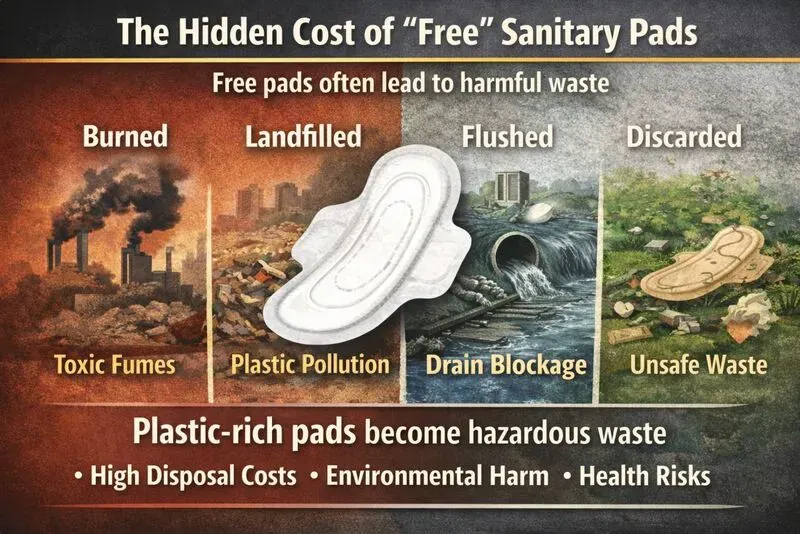
🌍 Free sanitary pads are often celebrated as a win for dignity and access. But there’s a side of this story we rarely talk about.
In India, large-scale pad distribution through schools, government schemes, and CSR programs has focused almost entirely on upfront purchase cost and number of pads delivered, often driven by L1 (lowest-cost) pricing. What is rarely considered is what happens after the pad is used.
Plastic-based sanitary pads may appear “cheap” at the point of procurement. But once their full life cycle from raw material extraction to post-use disposal is taken into account, the real cost is far higher. Much of this cost never appears on balance sheets:
- Collection and segregation
- Incineration or landfill management
- Release of toxic gases into the air we breathe
- Contamination of soil and water systems
- Exposure of sanitation workers to hazardous waste
- Long-term public health and environmental damage.
When purchase cost and disposal cost are considered together, plastic-based pads are no longer inexpensive they are simply underpriced. In contrast, truly compostable pads, often labelled “expensive” due to higher upfront pricing, have far lower end-of-life costs, minimal environmental burden, and significantly better outcomes for both user health and ecological systems. Yet this comparison is seldom made.
The consequence of ignoring life cycle accountability is visible every day: Millions of plastic-rich sanitary pads are burned in low-temperature incinerators, dumped in landfills, choked in the drains or discarded in open spaces. This is not a failure of users. It seems like a design and policy failure.
When “free” pads are distributed without:
- Material and quality standards
- Defined disposal pathways
- Safe waste-management infrastructure
- Education on end-of-life impact or responsibility for post-use waste
The true cost is quietly shifted to communities, sanitation workers, ecosystems, and future generations.
Access matters. But access without accountability creates another crisis.
If menstrual health programs are to be truly empowering, sustainability cannot be an afterthought. Product choice, waste pathways, total cost of ownership, and local context must be integral to program design not an inconvenient footnote.
Because dignity doesn’t end at distribution. It extends to #health, #safety, and #environmentalsustainability
#MenstrualHealth #PeriodDignity #WASH #Sanitation #LifeCycleThinking #WasteManagement #CSR #MHM #SDG6 #SDG12